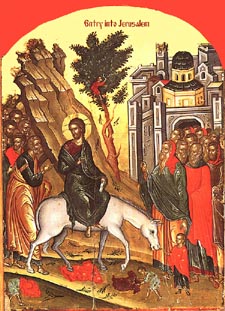
Palm Sunday is the celebration of the triumphant entrance of Christ into the royal city of Jerusalem. He rode on a colt for which He Himself had sent, and He permitted the people to hail Him publicly as a king. A large crowd met Him in a manner befitting royalty, waving palm branches and placing their garments in His path. They greeted Him with these words: “Hosanna! Blessed is he who comes in the name of the Lord, even the King of Israel! (John 12:13).
This day, together with the raising of Lazarus, is a sign pointing beyond themselves to the mighty deeds and events which consummate Christ’s earthly ministry. The time of fulfillment was at hand. Christ’s raising of Lazarus points to the destruction of death and the joy of resurrection, which will be accessible to all through His own death and resurrection. His entrance into Jerusalem is a fulfillment of the messianic prophecies about the king who will enter his holy city to establish a final kingdom. “Behold, your king is coming to you, humble, and mounted on an ass, and on a colt, the foal of an ass” (Zech 9:9).
Finally, the events of these triumphant two days are but the passage to Holy Week: the “hour” of suffering and death for which Christ came. Thus, the triumph in an earthly sense is extremely short-lived. Jesus enters openly into the midst of His enemies, publicly saying and doing those things which mostly enrage them. The people themselves will soon reject Him. They misread His brief earthly triumph as a sign of something else: His emergence as a political messiah who will lead them to the glories of an earthly kingdom.
Palm Sunday is considered a Feast Day, and in most traditions, fish, wine, and oil are eaten. Our coffee hour at SS George and Alexandra is usually celebrated with shared fish dishes.
For more information on Palm Sunday or the Orthodox Church in general, please contact Fr. Alexis at SS. George and Alexandra Church in Fort Smith, AR, or your local parish priest.
The Sunday of Forgiveness is the last Sunday prior to the commencement of Great Lent. During the pre-Lenten period, the services of the Church include hymns from the Triodion, a liturgical book that contains the services from the Sunday of the Publican and the Pharisee, the tenth before Pascha (Easter), through Great and Holy Saturday. On the Sunday of Forgiveness focus is placed on the exile of Adam and Eve from the Garden of Eden, an event that shows us how far we have fallen in sin and separated ourselves from God. At the onset of Great Lent and a period of intense fasting, this Sunday reminds us of our need for God’s forgiveness and guides our hearts, minds, and spiritual efforts on returning to Him in repentance.
Biblical Story
The Sunday of Forgiveness, the last of the preparatory Sundays before Great Lent, has two themes: it commemorates Adam’s expulsion from Paradise, and it accentuates our need for forgiveness. There are obvious reasons why these two things should be brought to our attention as we stand on the threshold of Great Lent. One of the primary images in the Triodion is that of the return to Paradise. Lent is a time when we weep with Adam and Eve before the closed gate of Eden, repenting with them for the sins that have deprived us of our free communion with God. But Lent is also a time when we are preparing to celebrate the saving event of Christ’s death and rising, which has reopened Paradise to us once more (Luke 23:43). So sorrow for our exile in sin is tempered by hope of our re-entry into Paradise.
The second theme, that of forgiveness, is emphasized in the Gospel reading for this Sunday (Matthew 6:14-21) and in the special ceremony of mutual forgiveness at the end of the Vespers on Sunday evening. Before we enter the Lenten fast, we are reminded that there can be no true fast, no genuine repentance, no reconciliation with God, unless we are at the same time reconciled with one another. A fast without mutual love is the fast of demons. We do not travel the road of Lent as isolated individuals but as members of a family. Our asceticism and fasting should not separate us from others, but should link us to them with ever-stronger bonds.
The Sunday of Forgiveness also directs us to see that Great Lent is a journey of liberation from our enslavement to sin. The Gospel lesson sets the conditions for this liberation. The first one is fasting—the refusal to accept the desires and urges of our fallen nature as normal, the effort to free ourselves from the dictatorship of the flesh and matter over the spirit. To be effective, however, our fast must not be hypocritical, a “showing off.” We must “appear not unto men to fast but to our Father who is in secret” (vv. 16-18).
The second condition is forgiveness—“If you forgive men their trespasses, your Heavenly Father will also forgive you” (vv. 14-15). The triumph of sin, the main sign of its rule over the world, is division, opposition, separation, hatred. Therefore, the first break through this fortress of sin is forgiveness—the return to unity, solidarity, love. To forgive is to put between me and my “enemy” the radiant forgiveness of God Himself. To forgive is to reject the hopeless “dead-ends” of human relations and to refer them to Christ. Forgiveness is truly a “breakthrough” of the Kingdom into this sinful and fallen world.
Icon of the Feast
The icon of the Sunday of the Last Judgment incorporates all of the elements of the parable from Matthew 25:31-46. Christ sits on the throne and before him the Last Judgment takes place. He is extending his hands in blessing upon the Theotokos on his right, and John the Baptist on his left. Seated on smaller thrones are the Apostles, represented by Peter and Paul, a depiction of the words of Christ in Matthew 19:28. (1.)
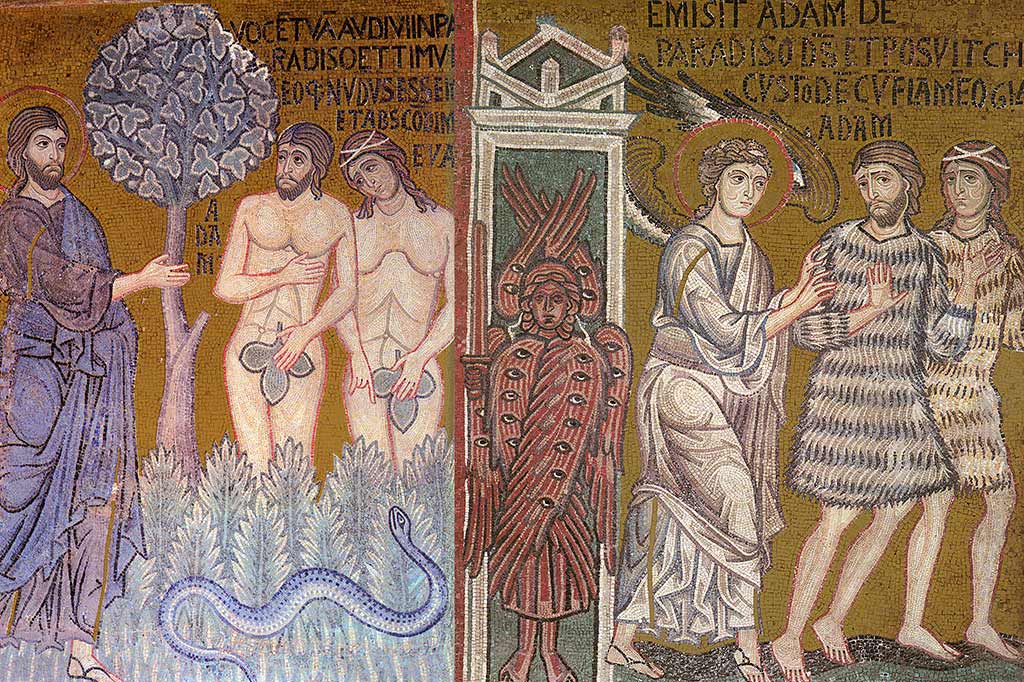
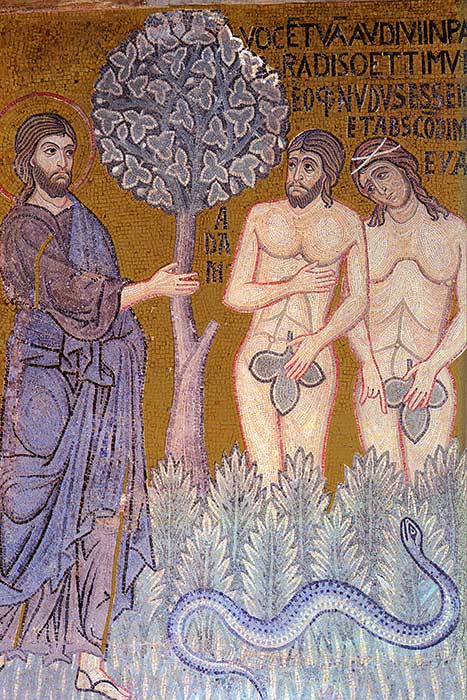
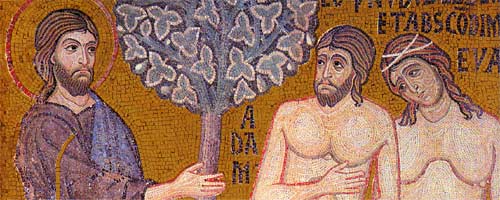
The icon shows Adam and Eve standing before Jesus Christ. Prior to their descent into sin through disobedience, Adam and Eve were blessed with a beautiful relationship of communion and fellowship with God. However, they were tempted by the devil appearing in the form of a serpent to disobey God and eat from the tree of the knowledge of good and evil (Genesis 2:15-17).
When they took of the fruit and sinned, they realized that they were naked. Further, when “they heard the sound of the Lord God walking in the garden”…they hid themselves “from the presence of the Lord” (3:8). The icon shows Adam and Eve attempting to cover themselves with fig leaves as they try to hide, and yet they stand ashamed before the Lord.
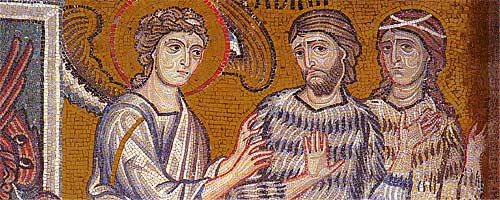
Because of their disobedience the Lord expelled them from the garden. The icon shows the Archangel of the Lord directing them out of Paradise, through the gate of Eden where God placed “the cherubim and a sword flaming and guarding the way to the tree of life” (3:23-24). Adam and Eve are dressed in the garments of skins made for them by God (3:20).
Orthodox Christian Celebration of the Sunday of Forgiveness
The Sunday of Forgiveness is commemorated with the Divine Liturgy of Saint John Chrysostom, which is preceded by the Matins service. A Great Vespers is conducted on Saturday evening. The hymns of the Triodion for this day are added to the usual prayers and hymns of the weekly commemoration of the Resurrection of Christ. The naming of the Sunday is taken from the commemoration of the Exile of Adam and Eve from Paradise and from the Gospel reading of the Divine Liturgy.
Scripture readings for the Sunday of the Last Judgment are: At the Orthros (Matins): The prescribed weekly Gospel reading. At the Divine Liturgy: Romans 13:11-14:4, Matthew 6:14-21.
The Sunday of Forgiveness is also known as Cheesefare Sunday. This is the last day that dairy products can be eaten before the Lenten fast. The full fast begins the following day on Clean Monday, the first day of Great Lent. On the evening of the Sunday of Forgiveness the Church conducts the first service of Great Lent, the Vespers of Forgiveness, a service that directs us further on the path of repentance and helps us to acknowledge our need for forgiveness from God and to seek forgiveness from our brothers and sisters in Christ. This is the first time that the Lenten prayer of St. Ephraim accompanied by prostrations is read. At the end of the service all the faithful approach the priest and one another asking for mutual forgiveness.
Orthodox Christians are encouraged to enter Great Lent in repentance and confession by attending these services, coming for the Sacrament of Confession, and dedicating themselves to worship, prayer, and fasting throughout the Lenten period. The first day of Lent, Clean Monday, signifies the beginning of a period of cleansing and purification of sins through repentance.
On the Saturday before this Sunday, the second of three Saturdays of the Souls are held. This is a special commemoration when the Church offers a Divine Liturgy and Memorial Service for the departed faithful. This is considered a universal commemoration of the dead. Through the memorial services, the Church is commending to God all who have departed and who are now awaiting the Last Judgment. This specific Saturday is a general commemoration of all the ascetic Saints of the Church, both men and women. As we set out on the Lenten fast we are reminded that we will make this journey as members of a family, supported by the intercessions of the Saints.
Hymns and Prayers of the Feast of the Prodigal Son Exapostelarion of Matins (Tone Two)
Wretch that I am I disobeyed Your good commandment, O my Lord. And being stripped of Your glory, alas, with shame I am laden. And I have been evicted from the pure delights of Paradise. O merciful and compassionate, have mercy on me who rightly has been deprived of Your goodness.
We were expelled of old, O Lord, from the Garden of Eden, for wrongly eating from the tree. But, O my God and Savior, You once again have restored us through Your Cross and Your Passion. Thereby, O Master, fortify and enable us purely to finish Lent and to worship Your holy resurrection, Pascha our saving Passover, by the prayers of Your Mother.
Prokeimenon of Vespers (Tone Plagal Fourth)
Idiomela: Turn not away Thy face from Thy child for I am afflicted; hear me speedily. Draw near to my soul and deliver me.
Stichos: Thy salvation, O God, hath set me up. The poor see and rejoice.
Kontakion (Tone Plagal Second)
O Master, Guide to wisdom, Giver of prudent counsel, Instructor of the foolish and Champion of the poor, make firm my heart and grant it understanding. O Word of the Father, give me words, for see, I shall not stop my lips from crying out to Thee: I am fallen, in Thy compassion have mercy on me.
Sources
The Lord Confronts the Disobedience of Adam & Eve; The Expulsion from Paradise, Nave Mosaic from Palatine Chapel, Palermo, Sicily. Mid 12th Century. The Lenten Triodion. translated by Mother Mary and Kallistos Ware (South Canaan, PA: St. Tikhon’s Seminary Press, 1994), pp. 46-47, 168-188. Schmemann, Alexander. Great Lent: Journey to Pascha (Crestwood, New York: St. Vladimir’s Seminary Press, 1969), pp. 27-30. Barrois, Georges. Scripture Readings in Orthodox Worship (Crestwood, New York: St. Vladimir’s Seminary Press, 1977), pp. 29-30. Farley, Donna. Seasons of Grace: Reflections on the Orthodox Church Year (Ben Lomond, CA: Conciliar Press, 2002), pp. 87-90.
The Sunday of the Last Judgment is the third Sunday of a three-week period prior to the commencement of Great Lent. During this time, the services of the Church have begun to include hymns from the Triodion, a liturgical book that contains the services from the Sunday of the Publican and the Pharisee, the tenth before Pascha (Easter), through Great and Holy Saturday. On this day, focus is placed on the future judgment of all persons who will stand before the throne of God when Christ returns in His glory.
Biblical Story
The commemoration for this Sunday is taken from the parable of our Lord Jesus Christ concerning his Second Coming and the Last Judgment of all, both the living and the dead. In Matthew 25:31-46, Christ speaks about what will happen at this specific point in time when He will “come in His glory, and all the holy angels with Him” (v. 31).
At His coming, “He will sit on the throne of His glory,” and all of the nations will be gathered before Him. He will separate them “as a shepherd divides his sheep from the goats” (v. 32). The sheep will be placed on His right hand, and the goats on the left.
To the sheep, He will say “Come, you blessed of My Father, inherit the kingdom prepared for you from the foundation of the world” (vv. 33-34)
This kingdom is offered to the sheep because of their compassion and service to those in need. Jesus says, “…for I was hungry and you gave Me food; I was thirsty and you gave Me drink; I was a stranger and you took Me in; I was naked and you clothed Me; I was sick and you visited Me; I was in prison and you came to Me.”
The sheep, who are the righteous chosen for the kingdom, will ask how this could be so.They will ask Jesus when was He hungry or thirsty, a stranger, naked, and in prison. He will answer them by saying, “Assuredly, I say to you, inasmuch as you did it to the least of these My brethren, you did it to me” (vv. 35-40).
Christ the King, seated on His throne of judgment, will then turn to the goats on His left and say, “Depart from Me, you cursed, into the everlasting fire prepared for the devil and his angels” (v. 41). He will condemn them because they did not feed Him when He was hungry, give Him drink when He was thirsty, take Him in when He was a stranger, clothe Him when He was naked, visit Him when He was sick or in prison.
The goats will ask the Lord, “When did we see You hungry or thirsty or a stranger or naked or sick or in prison, and did not minister to You?” Then He will answer them saying, “Assuredly, I say to you, inasmuch as you did not do it to one of the least of these, you did not do it to me” (vv. 42-45).
Jesus concludes His words on the Last Judgment by stating that those on the left “will go away into everlasting punishment, but the righteous into eternal life” (v. 46).
On the past two Sundays of this pre-Lenten period, the focus was placed on God’s patience and limitless compassion, of His readiness to accept every sinner who returns to Him. On this third Sunday, we are powerfully reminded of a complementary truth: no one is so patient and so merciful as God, but even He does not forgive those who do not repent. The God of love is also a God of righteousness, and when Christ comes again in glory, He will come as our Judge. Such is the message of Lent to each of us: turn back while there is still time, repent before the End comes.
This Sunday sets before us the eschatological dimension of Lent: the Great Fast is a preparation for the Second Coming of the Savior, for the eternal Passover in the Age to Come, a theme that is also the focus of the first three days of Holy Week. But the judgment is not only in the future. Here and now, each day and each hour, in hardening our hearts toward others and in failing to respond to the opportunities we are given of helping them, we are already passing judgment on ourselves.
Another theme of this Sunday is that of love. When Christ comes to judge us, what will be the criterion of His judgment? The parable of the Last Judgment answers: love—not a mere humanitarian concern for abstract justice and the anonymous “poor,” but concrete and personal love for the human person—the specific persons that we encounter each day in our lives.
Christian love is the “possible impossibility” to see Christ in another person, whoever he or she is, and whom God, in His eternal and mysterious plan, has decided to introduce into my life, be it only for a few moments, not as an occasion for a “good deed” or an exercise in philanthropy, but as the beginning of an eternal companionship in God Himself.
The parable of the Last Judgment is about Christian love. Not all of us are called to work for “humanity,” yet each one of us has received the gift and the grace of Christ’s love. We know that all persons ultimately need this personal love—the recognition in them of their unique soul in which the beauty of the whole creation is reflected in a unique way. We also know that people are in prison and are sick and thirsty and hungry because that personal love has been denied them. And, finally, we know that however narrow and limited the framework of our personal existence, each one of us has been made responsible for a tiny part of the Kingdom of God, made responsible by that very gift of Christ’s love. Thus, on whether or not we have accepted this responsibility, on whether we have loved or refused to love, shall we be judged.
Icon of the Feast
The icon of the Sunday of the Last Judgment incorporates all of the elements of the parable from Matthew 25:31-46. Christ sits on the throne and before him the Last Judgment takes place. He is extending his hands in blessing upon the Theotokos on his right, and John the Baptist on his left. Seated on smaller thrones are the Apostles, represented by Peter and Paul, a depiction of the words of Christ in Matthew 19:28.
Proceeding from the throne are the scrolls pronouncing the judgment upon the sheep and the goats. The faithful are received with the words that are written on the scroll to the right of Christ the Judge, “Come, you blessed of My Father, and inherit the kingdom” (v. 34). The scroll on the left condemns the unfaithful with the words, “Depart from me you cursed, into the everlasting fire” (v. 41).
Before the throne, the progenitors of the human race, Adam and Eve, bow before Christ. In the center of the icon is the Archangel Michael. He is holding the scales of judgment and is surrounded by the books that contain the works of each person (Revelation 20:11-13). Also shown are the angels with trumpets announcing the return of Christ and signaling the resurrection of the dead and the commencement of the Last Judgment (I Thessalonians 4:16-17).
To the left of the Archangel are both the living and the dead who are approaching the throne and Christ the judge. Whereas Adam and Eve are representative of all of humanity, this part of the icon shows that both the living and the dead will stand before Christ.
At the bottom right of the icon is the everlasting fire prepared for the devil and the demons, and also for those who are not found worthy to inherit the Kingdom of God.
The icon offers a clear image of the theme of judgment with Christ on His throne, the Archangel with the scales and books, and the anticipation of the sentence of everlasting punishment for the unrighteous and the reward of eternal life for the righteous.
Orthodox Christian Celebration of the Feast of the Last Judgement
The Sunday of the Last Judgment is commemorated with the Divine Liturgy of Saint John Chrysostom, which is preceded by the Matins service. A Great Vespers is conducted on Saturday evening. The hymns of the Triodion for this day are added to the usual prayers and hymns of the weekly commemoration of the Resurrection of Christ. The naming of the Sunday is related to the reading of the story from the Gospel at the Divine Liturgy.
Scripture readings for the Sunday of the Last Judgment are: At the Orthros (Matins): The prescribed weekly Gospel reading. At the Divine Liturgy: I Corinthians 8:8-9:2; Matthew 25:31-46.
The Sunday of the Last Judgment is also known as Meatfare Sunday. This is the last day that meat can be eaten before the Lenten fast. Dairy products are allowed on each day of this week, even Wednesday and Friday. The next Sunday is the Sunday of Cheesefare, It is the last day that dairy products can be eaten prior to the commencement of Great Lent.
On the Saturday before this Sunday, the first of three Saturdays of the Souls are held. This is a special commemoration on this and the next two Saturdays, when the Church offers a Divine Liturgy and Memorial Service for the departed faithful. This is considered a universal commemoration of the dead. It is closely related to the theme of the Sunday of the Last Judgment since the services focus on the Second Coming of Christ and the resurrection of the dead. Through the memorial services, the Church is commending to God all who have departed and who are now awaiting the Last Judgment.
Hymns and Prayers of the Feast of the Prodigal Son
Doxastikon of Matins (First Mode)
Glory to the Father, and to the Son, and to the Holy Spirit; now and ever and unto ages of ages. Amen.
Let us go before, O brethren, and cleanse ourselves for the Queen of virtues; for behold she hath come bringing to us fortune of good deeds, quenching the uprisings of passion and reconciling the wicked to the Master. Let us welcome her, therefore, shouting to Christ God, O thou who arose from the dead, keep us uncondemned, who glorify Thee, O Thou who alone art sinless.
Kontakion (First Mode)
When Thou comest, O God, upon the earth with glory, the whole world will tremble. The river of fire will bring men before Thy judgment seat, the books will be opened and the secrets disclosed. Then deliver me from the unquenchable fire, and count me worthy to stand on Thy right hand, Judge most righteous.
References
The Lenten Triodion. translated by Mother Mary and Kallistos Ware (South Canaan, PA: St. Tikhon’s Seminary Press, 1994), pp. 45-46, 150-167.
Schmemann, Alexander. Great Lent: Journey to Pascha (Crestwood, New York: St. Vladimir’s Seminary Press, 1969), pp. 23-26.
Barrois, Georges. Scripture Readings in Orthodox Worship (Crestwood, New York: St. Vladimir’s Seminary Press, 1977), pp. 26-29.
Farley, Donna. Seasons of Grace: Reflections on the Orthodox Church Year (Ben Lomond, CA: Conciliar Press, 2002), pp. 84-86.
Icon of the Last Judgement provided by ΕΚΔΟΣΗ και ΕΠΙΣΚΟΠΟΥ , ΓΑΛΑΚΤΙΩΝΟΣ ΓΚΑΜΙΛΗ ΤΗΛ. 4971 882, ΕΚΤΥΠΟΣΗ Μ. ΤΟΥΜΠΗΣ Α.Ε.
The Sunday of the Prodigal Son is the second Sunday of a three-week period prior to the commencement of Great Lent. On the previous Sunday, the services of the Church began to include hymns from the Triodion, a liturgical book that contains the services from the Sunday of the Publican and the Pharisee, the tenth before Pascha (Easter), through Great and Holy Saturday. As with the Sunday of the Publican and the Pharisee, the theme of this Sunday is repentance, and the focus on the parable of the Prodigal Son leads Orthodox Christians to contemplate the necessity of repentance in our relationship with our Heavenly Father.
Biblical Story
The name for this Sunday is taken from the parable of our Lord Jesus Christ found in Luke 15:11-32. The parable is the story of a man and his two sons. The youngest of the sons asks his father to give him his inheritance. The father does this, and soon after the son leaves and journeys to a distant country (vv. 11-13).
After the younger son arrives, he squanders all of his possessions with “prodigal” living. Within a short period of time, he wastes everything. A severe famine comes, but he has nothing and falls into great need (vv. 13-14).
He is able to find work feeding swine, but this does not improve his situation. The Scriptures say, “He would gladly have filled his stomach with the pods that the swine ate, but no one gave him anything” (vv. 15-16).
The parable says that in the midst of his dire conditions, he came to himself. He realized that his father’s hired servants have enough to eat and food to spare, while he perishes with hunger. He says, “I will arise and go to my father and will say to him, ‘Father, I have sinned against heaven and before you, and I am no longer worthy to be called your son. Make me like one of your hired servants’” (vv. 17-19).
He arose and returned to his father. But as he approached, his father saw him at a great distance. The father had compassion on his son, ran to meet him, embraced him, and kissed him. The son admitted his sinfulness and his unworthiness to be called a son, but in his joy at the return of his son, the father called his servants to bring the best robe, a ring for his son’s finger, and sandals for his feet. He also called for the fatted calf to be killed for a feast. He exclaimed, “For this my son was dead and is alive again; he was lost and is found” (vv. 20-24).
While they were feasting and celebrating the return of the prodigal son, the older son comes and inquires about what is happening. He is told that his brother had returned and that his father has received him with a feast. The older brother becomes angry and will not go in to the feast. The father comes out and pleads with him, but the older son answers by saying he has been faithful to his father for many years and yet the father never gave him the opportunity for such feasting. He expresses his anger and jealousy over his brother who was received in such a manner after he squandered his inheritance (vv. 25-30).
The father responds by telling his oldest son, “You are always with me, and all that I have is yours. It was right that we should make merry and be glad, for your brother was dead and is alive again, and was lost and is found” (vv. 31-32).
The parable of the Prodigal Son forms an exact icon of repentance at its different stages. Sin is exile, enslavement to strangers, hunger. Repentance is the return from exile to our true home; it is to receive back our inheritance and freedom in the Father’s house. But repentance implies action: “I will rise up and go…” (v. 18). To repent is not just to feel dissatisfied, but to make a decision and to act upon it.
In the words of our Lord, we also learn of three things through this parable: the condition of the sinner, the rule of repentance, and the greatness of God’s compassion. The reading of this parable follows the Sunday of the Publican and the Pharisee so that, seeing in the person of the Prodigal Son our own sinful condition, we might come to our senses and return to God through repentance. For those who have fallen into great despair over their sins thinking that there is no forgiveness, this parable offers hope. The Heavenly Father is patiently and lovingly waiting for our return. There is no sin that can overcome His love for us.
Finally, this parable offers us insight into the world in which we live. It is a world where the activities of people are disconnected and not ordered toward the fulfillment of God’s divine purpose for life. It is a world of incoherent pursuits, of illusory strivings, of craving for foods and drinks that do not satisfy, a world where nothing ultimately makes sense, and a world engulfed in untruth, deceit and sin. It is the exact opposite of the world as created by God and potentially recreated by his Son and Spirit. There is no cure for the evils of our age unless we return to God. The world in which we live is not a normal world, but a wasteland. This is why in the Slavic tradition of the Orthodox Church the reading of Psalm 137 is added to the Matins service for this and the following two Sundays. This nostalgic lament of the Hebrew exiles states: “By the streams of Babylon we sat and wept as we remembered Zion. On the willows we hung our harps, for how could we sing the Lord’s song in a strange land” (Psalm 137).
Here we can see the challenge of life in this world and the alienation from God that can happen when sin reigns in our lives. As a result of sin in our lives, we lose the joy of communion with God, we defile and lose our spiritual beauty, and we find ourselves far away from our real home, our real life. In true repentance, we realize this, and we express a deep desire to return, to recover what has been lost. On this day the Church reminds us of what we have abandoned and lost, and beckons us to find the desire and power to return. Our Heavenly Father is waiting and ready to receive us with His loving forgiveness and His saving embrace.
Icon of the Feast
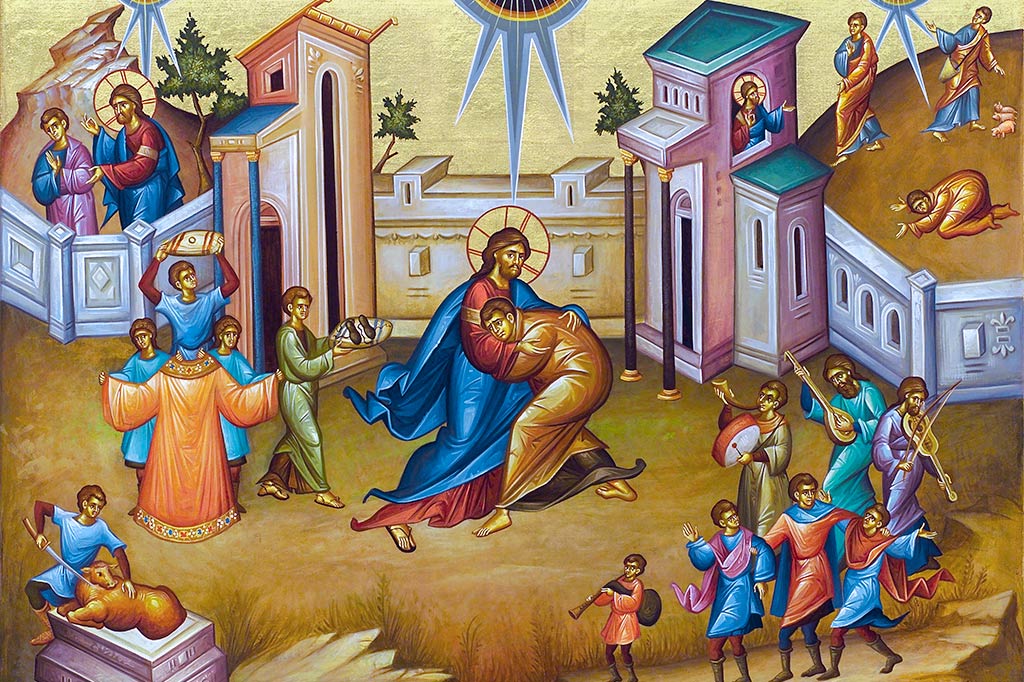
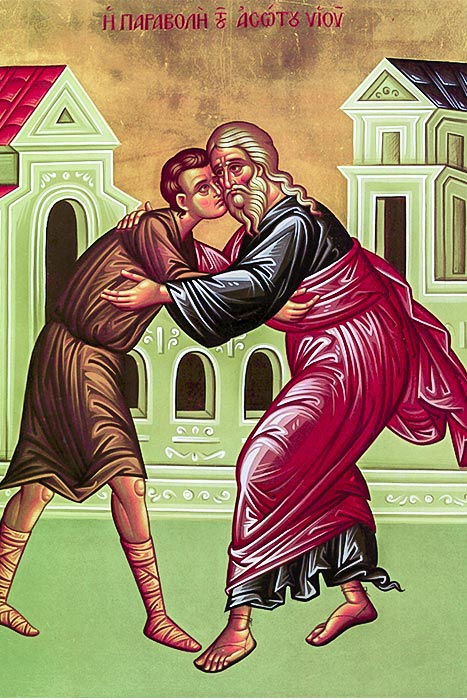
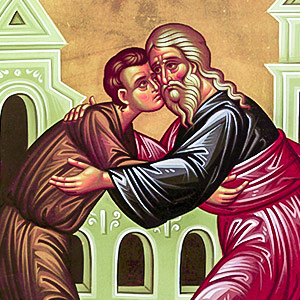
The icon of the Sunday of the Prodigal Son shows the prodigal being received by his father upon his return. We are presented with an image of a warm and loving embrace, the son showing his need for his father, an attitude that represents repentance, love, and hope for renewal and restoration. The father is shown full of compassion for his son, having born the burden of his sin and suffering, but now filled with joy that he has returned.
Orthodox Christian Celebration of the Feast of the Prodigal Son
The Sunday of the Prodigal Son is celebrated with the Divine Liturgy of Saint John Chrysostom, which is preceded by the Matins service. A Great Vespers is conducted on Saturday evening. The hymns of the Triodion for this day are added to the usual prayers and hymns of the weekly commemoration of the Resurrection of Christ. The naming of the Sunday is related to the reading of the story from the Gospel at the Divine Liturgy.
Scripture readings for the Sunday of the Prodigal Son are: At the Orthros (Matins): The prescribed weekly Gospel reading. At the Divine Liturgy: I Corinthians 6:12-20 ; Luke 15:11-32 .
For the week that follows the Sunday of the Prodigal Son, fasting is observed on Wednesday and Friday. This is the last week that meat is allowed on non-fasting days. The next Sunday is the Sunday of the Last Judgment, also known as Meatfare Sunday. It is the last day that meat can be eaten prior to the fast of Great Lent.
Hymns and Prayers of the Feast of the Prodigal Son
Kontakion (Tone Three)
When I disobeyed in ignorance Thy fatherly glory, I wasted in iniquities the riches that Thou gavest me. Wherefore, I cry to Thee with the voice of the prodigal son, saying, I have sinned before Thee, O compassionate Father, receive me repentant, and make me as one of Thy hired servants.
References
The Lenten Triodion. translated by Mother Mary and Kallistos Ware (South Canaan, PA: St. Tikhon’s Seminary Press, 1994), pp. 44-45, 112-123.
Schmemann, Alexander. Great Lent: Journey to Pascha (Crestwood, New York: St. Vladimir’s Seminary Press, 1969), pp. 21-23.
Barrois, Georges. Scripture Readings in Orthodox Worship (Crestwood, New York: St. Vladimir’s Seminary Press, 1977), pp. 24-26.
Farley, Donna. Seasons of Grace: Reflections on the Orthodox Church Year (Ben Lomond, CA: Conciliar Press, 2002), pp. 81-83.
Icon of the Prodigal Son depicting the Father embracing his son, provided by Theologic and used with permission.
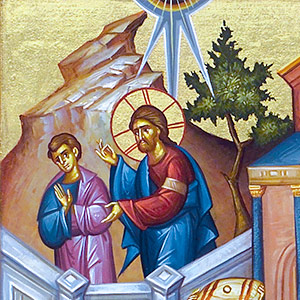
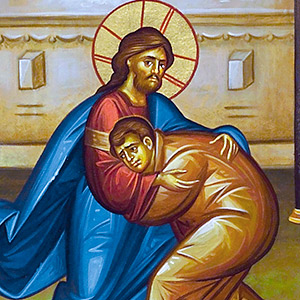
Icon of the Prodigal Son depicting Christ as the Father, provided by Athanasios Clark and used with permission.
This feast, celebrated on February 2, is known in the Orthodox Church as The Presentation of Christ in the Temple. Another name for the feast is The Meeting of our Lord. Roman Catholic and Protestant Christians call the feast, The Purification of the Holy Virgin. About 450 AD in Jerusalem, people began the custom of holding lighted candles during the Divine Liturgy of this feast day. Therefore, some churches in the West refer to this holy day as Candlemas. The Feast of the Presentation concludes the observances related to the Nativity of Christ, a period that opened on November 15 with the beginning of the Nativity fast.
Biblical Story
The story of the Presentation is told in Luke 2:22-29. Mary and Joseph were faithful Jews and observed their religious customs. An important custom was for the couple to take their first-born son to the Temple. The baby was taken to the Temple forty days after his birth and was dedicated to God. In addition, if the parents were wealthy, they were to bring a lamb and a young pigeon or a turtle dove to be offered as a sacrifice at the Temple. The custom provided that if the parents were poor, they were to offer two pigeons or two turtle doves for the sacrifice.
Joseph and Mary were not wealthy, so they took two turtle doves with them to offer as a sacrifice at the Temple.
When Jesus was forty days old, Mary and Joseph took Him to the Temple in Jerusalem. They were not wealthy, so they took two turtle doves with them to offer as a sacrifice at the Temple. As they arrived at the Temple, Mary and Joseph were met by a very old man named Simeon. He was a holy man and was noted as a very intelligent scholar. Simeon spent much time studying about the prophets of Israel. It was during his studies that he learned of the coming of the Messiah. The Jewish people were waiting for the Messiah to come and deliver Israel from their conquerors. From that time on, Simeon spent his time praying for the Messiah to come. He spent many years in prayer. Finally, while Simeon was praying he heard the voice of God. God promised Simeon that he would not die until he had seen the Messiah.
When Simeon saw Jesus, he took the baby in his arms and blessed the Lord and said:”Lord, now let Your servant go in peace according to Your promise, because my eyes have seen Your salvation which you have prepared before the face of all peoples, a light to bring revelation to the Gentiles, and the glory to your people Israel.”
Simeon took Jesus in his arms and praised God.
Also, in the Temple was Anna the Prophetess. She had been a widow for many years. Anna was about eighty-four years old and spent her time in the Temple worshiping, fasting, and praying. When she saw the Christ Child she praised God and spoke of him to all who were awaiting the Messiah.
After Jesus was presented in the Temple, the family returned to Galilee to the town of Nazareth. The Bible tells us that Jesus grew and became strong, and was filled with wisdom.
Icon of the Feast
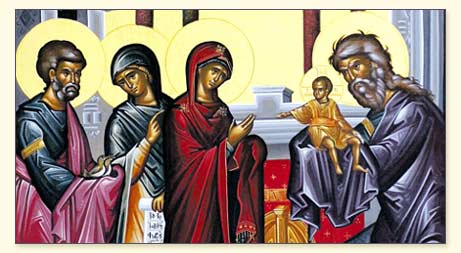
The Holy Icon shows that the meeting takes place inside the Temple and in front of the altar. The altar has a book or a scroll on it and is covered by a canopy. The Theotokos stands to the left and is holding out her hands in a gesture of offering. The one hand of the Theotokos is covered by her cloak or as it is known, the maphorion. She has just handed her Son to Simeon.
The Theotokos is holding out her hands in a gesture of offering and humility.
Christ is shown as a child, but He is not in swaddling clothes. He is clothed in a small dress and his legs are bare. Jesus appears to be giving a blessing. Simeon holds Jesus with both hands which are covered. This shows the reverence Simeon had for the Messiah. Simeon is bare headed and there is nothing to show that he is a priest. Some biblical scholars say that Simeon was probably a priest of the Temple or a Doctor of the Law.
Joseph is behind the Theotokos. He is carrying the two turtle doves for the sacrifice. Anna the Prophetess is also standing behind the Theotokos and is pointing to the Christ child.
Joseph offers the sacrifice of a poor family while Anna the Prophetess praises God and “speaks about the child to all who were looking for the redemption of Jerusalem.” Luke 2: 38
The words Simeon spoke when he saw the Christ Child are known as “St. Simeon’s Prayer.” This prayer is sung daily at the evening Vespers services of the Orthodox Church.
In the Orthodox Church, both baby boys and baby girls are taken to the Church on the fortieth day after their birth. This is done in remembrance of the Theotokos and Joseph taking the infant Jesus to the Temple.
Orthodox Celebration of the Feast of the Presentation
This Feast of our Lord is celebrated with the Divine Liturgy of Saint John Chrysostom, which is conducted on the day of the Feast and preceded by the Matins service. A Great Vespers is conducted on the evening before the day of the Feast. Scripture readings for the Feast are the following: at Great Vespers – extracts from Exodus 12:15-13:16; Leviticus 12 and Numbers 8; Isaiah 6:1-12, and 19:1,3-5,12,16,19-21; at Matins – Luke 2:25-32; at the Divine Liturgy –Hebrews 7:7-17 and Luke 2:22-40.
Resources
The Story of the Icons by Dr. Mary Paloumpis Hallick.
The Festal Menaion translated by Mother Mary (South Canaan, PA: St. Tikhon’s Seminary Press, 1969) p. 60.
The Incarnate God: The Feasts of Jesus Christ and the Virgin Mary, Cathering Aslanoff, editor and Paul Meyendorff, translator (Crestwood, NY: St. Vladimir’s Seminary Press, 1995).
Festival Icons for the Christian Year by John Baggley (Crestwood, NY: St. Vladimir’s Seminary Press, 2000), pp. 40-47.
The Sunday of the Publican and the Pharisee is the first Sunday of a three-week period prior to the commencement of Great Lent. It marks the beginning of a time of preparation for the spiritual journey of Lent, a time for Orthodox Christians to draw closer to God through worship, prayer, fasting, and acts of charity. It is also on this day that the Triodion is introduced, a liturgical book that contains the services from this Sunday, the tenth before Pascha (Easter), to Great and Holy Saturday.
Biblical Story
The name for this Sunday is taken from the parable of our Lord Jesus Christ found in Luke 18:10-14. This is the story of two men, one a Pharisee, a member of a Jewish sect known for its diligent observance of the Law, and the other a Publican, a government official charged with the responsibility of collecting taxes.
Both men enter the temple, and the Pharisee stands openly and prays, thanking God that he is not like other men, specifically extortioners, the unjust, adulterers, “or even this tax collector” (v. 11). He then begins to list his religious accomplishments by stating, “I fast twice a week, and I give tithes of all that I possess” (v. 12).
In direct contrast to the pride of the Pharisee, the Publican goes to a place where he will not be noticed by others and beats his breast saying, “God, be merciful to me a sinner!” (v. 13).
Having told this story, Jesus affirms that it was the Publican who returned home justified and forgiven rather than the Pharisee. He states, “Everyone who exalts himself will be humbled, and he who humbles himself will be exalted” (v. 14).
The theme of this parable is repentance. Repentance is the door through which we enter Lent, the starting-point of the journey to Pascha. To repent signifies far more than self-pity or futile regret over things done in the past. The Greek term metanoia means “change of mind.” To repent is to be renewed, to be transformed in our inward viewpoint, to attain a fresh way of looking at our relationship with God and with others. The fault of the Pharisee is that he has no desire to change his outlook; he is complacent, self-satisfied, and so he allows no place for God to act within him. The Gospel depicts him as a man that is pleased only with himself who thinks that he has complied with all of the requirements of religion. But in his pride, he has falsified the meaning of true religion and faith. He has reduced these to external observations, measuring his piety by the amount of money he gives.
The Publican, on the other hand, truly longs for a “change of mind.” He humbles himself, and his humility justifies him before God. He becomes, in the words of the Sermon on the Mount (Matthew 5:3), “poor in spirit.” He acknowledges that he is a sinner, and he knows that salvation is only found in the mercy of God. Here we find an example of true humility, an essential aspect of repentance. A “change of mind” and the transformation of our lives can only happen when we humble ourselves before God, acknowledge our willingness to turn from sin, and receive His grace into our lives.
Our preparation for Lent thus begins with a prayer for humility, the beginning of true repentance. Through repentance, we can find and return to the true order of things, a restoration of our spiritual vision that will guide us in a very difficult and challenging world. By entering Great Lent in humility and repentance, we can attain deeper communion with God as we receive His forgiveness and He blesses by guiding us to greater spiritual heights.
Icon of the Feast
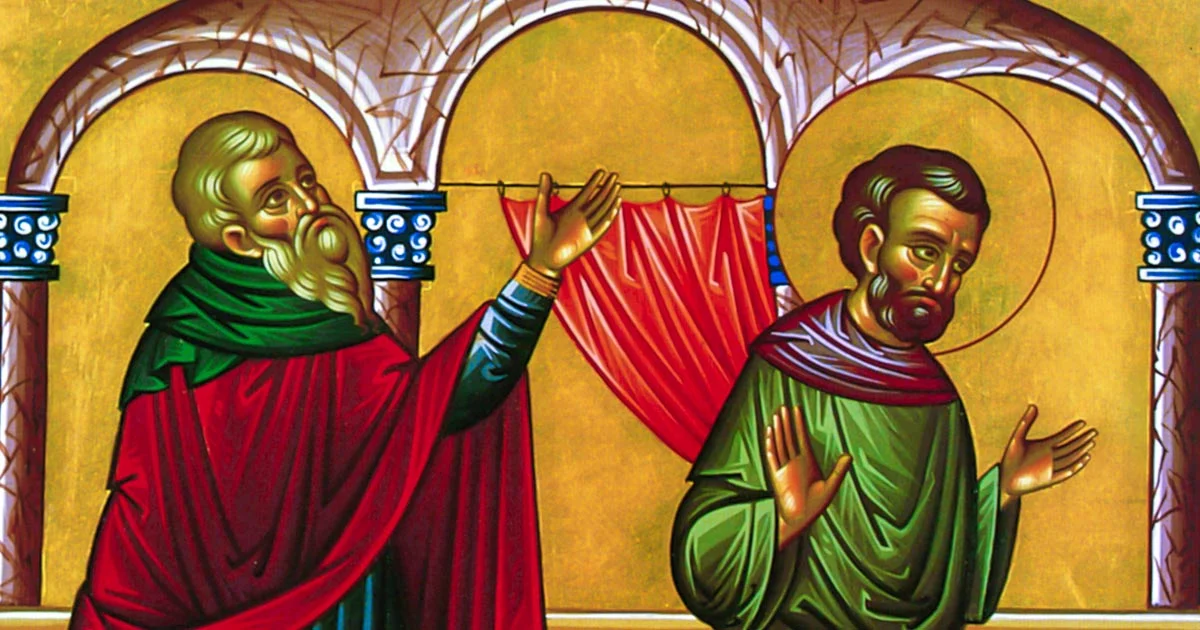
The icon of the Sunday of the Publican and the Pharisee shows both men in the manner in which they enter the temple to pray. The Pharisee goes to a very prominent place where others will see him. The positions of his hands indicate that he is addressing God by speaking of his stature and accomplishments. In contrast, the Publican enters and remains in a low place, far from the holiest parts of the temple. His posture shows his openness to God, his humility, and his petition for mercy.
The icon also shows the state of both men as they leave the temple. Following the words of Christ in Luke 18:14, the Publican has now been exalted in the kingdom of God because of his humility. He leaves the temple forgiven, and he shows that he remains open to the will of God. In contrast, the Pharisee leaves the temple unjustified, still in need of forgiveness. Because of his pride and lack of repentance, he will be humbled before God, the One who knows the condition of each person’s soul and who will offer the gift of salvation to those who come to Him in true repentance.
Orthodox Christian Celebration of The Sunday of the Publican and the Pharisee
The Sunday of the Publican and the Pharisee is celebrated with the Divine Liturgy of Saint John Chrysostom, which is preceded by the Matins service. A Great Vespers is conducted on Saturday evening. The hymns of the Triodion for this day are added to the usual prayers and hymns of the weekly commemoration of the Resurrection of Christ. The naming of the Sunday is related to the reading of the story from the Gospel at the Divine Liturgy.
Scripture readings for the Sunday of the Publican and the Pharisee are: At the Orthros (Matins): The prescribed weekly Gospel reading. At the Divine Liturgy: II Timothy 3:10-15 ; Luke 18:10-14 .
The week that follows the Sunday of the Publican and Pharisee is designated by the Church as a non-fasting week. All foods are allowed on everyday of the week, including Wednesday and Friday. This dispensation from fasting is offered as a way of indicating that Great Lent and a more intense fasting period is approaching.
Doxastikon of the Aposticha, Saturday Vespers (Tone plagal of the first)
Mine eyes are weighed down by my transgressions, and I cannot lift them up and see the height of heaven. But receive me, Savior, in repentance as the Publican and have mercy on me.
Troparion after “Have Mercy”, Matins Service (Tone plagal of the second)
Have mercy upon me, O God, according to Thy loving kindness and according to the multitude of Thy tender mercies blot out my transgressions.
As I ponder in my wretchedness the many evil things I have done, I tremble for the fearful day of judgment. But, trusting in Thy merciful compassion, like David do I cry out to Thee: have mercy upon me, O God, in Thy great mercy.
Doxastikon of the Ainoi, Matins Service (Tone Plagal Fourth)
O Lord, Thou hast condemned the Pharisee who justified himself by boasting of his works, and Thou hast justified the Publican who humbled himself and with cries of sorrow begged for mercy. For Thou dost reject proudminded thoughts, but Thou dost not despise a contrite heart. Therefore in abasement we fall down before Thee who hast suffered for our sake: grant us forgiveness and great mercy.
Kontakion (Tone Four)
Let us flee the proud speaking of the Pharisee and learn the humility of the Publican, and with groaning let us cry unto the Savior: Be merciful to us, for Thou alone art ready to forgive.
References
The Lenten Triodion. translated by Mother Mary and Kallistos Ware (South Canaan, PA: St. Tikhon’s Seminary Press, 1994), pp. 44, 99-111.
Schmemann, Alexander. Great Lent: Journey to Pascha (Crestwood, New York: St. Vladimir’s Seminary Press, 1969), pp. 18-21.
Barrois, Georges. Scripture Readings in Orthodox Worship (Crestwood, New York: St. Vladimir’s Seminary Press, 1977), pp. 21-24.
Farley, Donna. Seasons of Grace: Reflections on the Orthodox Church Year (Ben Lomond, CA: Conciliar Press, 2002), pp. 77-80.
Icon of the Publican and the Pharisee provided by Theologic and used with permission.
The commemoration of the Nativity of our Lord, the Baptism of our Lord, and the events related to them developed over time in the life and practice of the Church. Originally celebrated together on the same day, their celebrations – and the sequence of 12 days in between them – offers the faithful a festal period of great joy.
History
As they designated dates to commemorate events in Jesus’ life, the early Christian Church selected January 6 as the date to observe both the birth and baptism of Christ. In the early 4th century it was felt by the church leadership that a distinction should be made between the two observances. They selected Dec 25 to be the date to celebrate the birth of Christ and kept Jan 6 to be the baptism.
The selection of Dec 25 also addressed a second issue. The end of December was filled with pagan gatherings and festivities (in honor of the “sun god” as he became victorious over the “god of darkness” as the days slowly began to become longer (the winter solstice). Christians were falling back to pagan temptations with these festivities, thus the church fathers wanted to provide them with their own reason to celebrate. This reason of course became the birth of the Son of God (who made the sun).
Once Christmas Arrives
Our Orthodox Church today celebrates highly and with great festivity and joy! Once Christmas arrives on December 25, we enter a new liturgical period. The major period runs 40 days, from Jesus’ Birth to His 40 day Presentation to the Temple (Feb 2). Within these 40 days is some sub-division.
From December 25 to January 6, there became a 12-day period from the one major celebration to the next major observance. Thus, we have the “12 days of Christmas” that bridge the birth with the baptism and it became a festal period of time of great joy and celebration. As time progressed January 6 began to be called the “little Christmas.”
We have the 7 day Christmas tide which are part of the 12 Days of Christmas, focusing on immediate events up to His naming & Circumcision on the 8th day (January 1). Henceforth, we begin to prepare for the observance of His Baptism when He was 30 years old.
The Baptism of Our Lord
In the Orthodox Church January 6 is officially called the Baptism of our Lord – Theophany (sometimes called simply Epiphany). Theophany means “God’s appearance” and Epiphany simply “appearance”. On the day of Jesus’ baptism, the Holy Trinity was made manifest with the appearance of the dove and the voice that was heard from the sky (Matt 3:13 – 17).
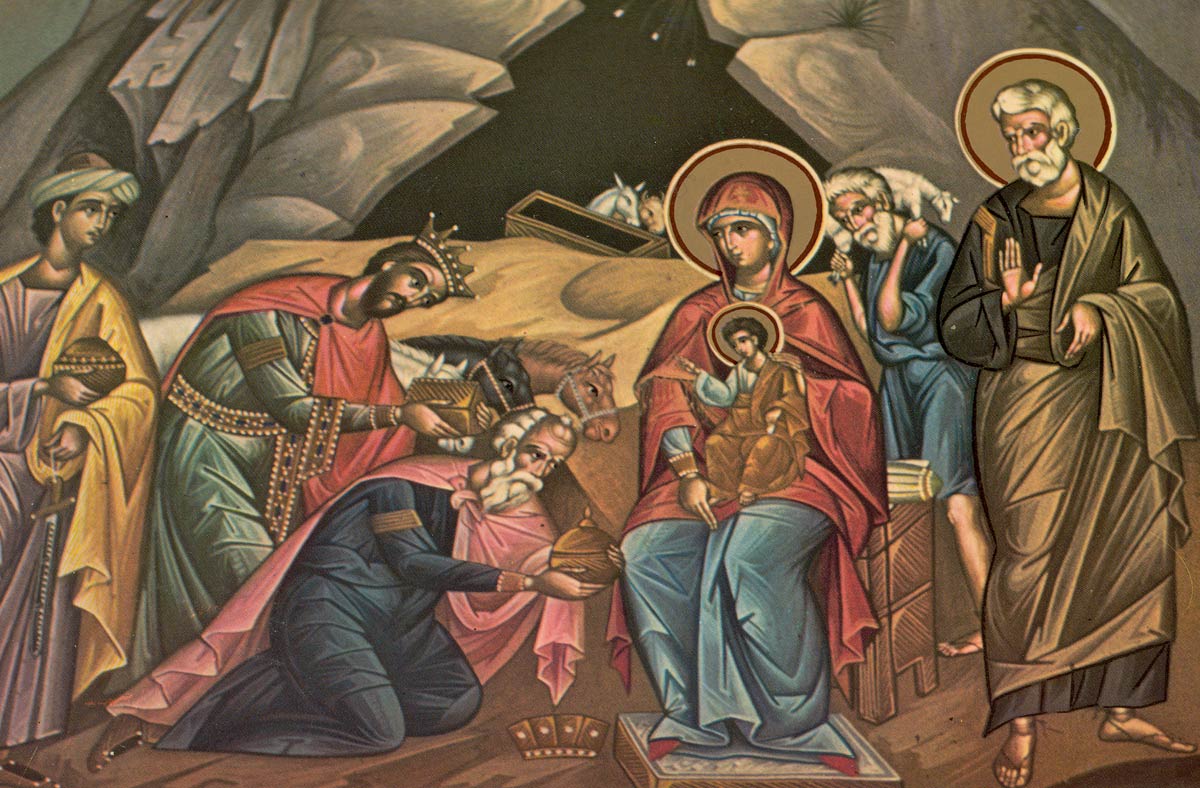
The Catholic Church later in history changed January 6 to be the arrival of the Wise men and made the Baptism to be the Sunday after January 6. In our Orthodox observances, the arrival of the Wise men is combined on the same day as the birth. The Armenian Church still retains January 6 as their Christmas commemoration.
The Twelve Days of Christmas
These 12 days that comprise the “12 days of Christmas” also include other observances on various levels. The first level are events that are directly associated to Christ’s birth in the flesh, including the murder of the 14,000 baby boys that Herod ordered when Jesus was born (December 29) and the 8-day naming of Jesus (January 1).
A second level of observances during these 12 days are commemorations of people from the earliest decades of the spread of the Christian faith after the death and resurrection of Christ and Pentecost, such as St. Stephen (one of the first of the 7 deacons) who became the first martyr in Christianity (December 27); and the “seventy” as they are known, these being the 70 apostles that the 12 apostles trained and sent off to travel and preach (January 4).
The third level of commemorations of these 12 days are for those who in later centuries lived and honored Christ in marvelous ways and became saints of the church, such as St Melanie of Rome from the 5th century (December 31), St Basil the Great from the 4th century era (January 1), and St Sylvester, Bishop of Rome also from the 4th century (Jan 2).
In its development over many centuries, the twelve days of Christmas that we celebrate today have become a theological and historical cornucopia of both the life of Christ and the life of the Church through its Christian Witness. What follows is a brief review of the themes from each of the twelve days of Christmas.
Day 1 – Dec 25 – The Nativity in the Flesh of our Lord, God and Saviour Jesus Christ
The Shepherd’s worship and the visit of the wise men from the East.
Day 2 – Dec. 26 – Synaxis of the Virgin
Gives Glory and Praise to her, who bore our Lord. Also on the 26th is the commemoration of the Flight into Egypt when an angel warned Joseph of King Herod’s plans to kill the children in Bethlehem.
Day 3 – Dec. 27 – St. Stephen the Deacon and 1st Martyr
He was the 1st of the 7 deacons in the “start up” Christian Church (Acts 7) who was stoned to death by the Jews, in 34 A.D. Tradition says that the Theotokos & St. John the Theologian witnessed the stoning.
Day 4 – Dec. 28 – 20,000 Martyrs of Nicomedia (men, women and children)
An event in 302 AD when the wicked Emperor Maximian Hercules, while visiting in Nicomedia learned of the large number of Christians living there and devised a means to get rid of them. It was the days preceding Christmas that he visited so, on Christmas, as the Christians were in church….his soldier’s surrounded the church, so no one could leave. The Emperor’s envoy gave them a choice to deny Christ and offer sacrifice to the pagan idols, or, be burned to death. The congregation chose death (in fact catechumens were quickly baptized). The soldiers set fire on all 4 sides of the church and the building burned for 5 days The smoke had a fragrant scent and a golden light surrounded the church.
Day 5 – Dec 29 – 14,000 children of Bethlehem (Holy Innocents)
King Herod was furious hearing from the wise men about a new born King in Bethlehem, and ordered that all the babies, 2 yrs and under to be killed in Bethlehem and the surrounding area. This occurred, 1 yr. after the birth. Herod sought out Zachariah’s son, also newly born (John, who later became the Baptizer of Jesus) thinking that John would be the “New King”. When Zachariah refused to hand over baby John, Herod killed Zachariah as he also killed Simeon who had received Christ as the 40 day old baby Jesus. Angered with the Jews in general – Herod also killed Hyrcanes, their high priest and 70 elders from the Sanhedrin (their council). Herod was so enraged that “someone” would take his position – he also killed own brother and sister, as well as his wife and 3 of his sons! What a crazed man!
Day 6 – Dec 30 – Deacon Timon (one of the 7 Deacons)
Also counted as one of the 70 Apostles who became Bishop in Arabia. He died by crucifixion there in the third century (298AD). On the same day we have the martyrdom of St Anysia from Thessaloniki, born of wealthy and prominent parents. She was orphaned young. She assisted the poor and devoted herself to prayer and fasting. This was the time of Emperor Maximian Hercules again. One of his decrees was that anyone was free to kill Christians when and where they came across them, without trial or sentences. So as Anysia was out in the streets one day, a soldier approached her and confirmed through direct conversation with her, that she was a Christian. He ran her through with a knife under her rib and killed her. This was actually during the days that the pagans had their festival of the sun god (which ultimately became later on in history the date selected for the observance of Christ’s Birth).
Day 7 – Dec 31 – Nothing directly connected to Christmas per se, but 2 important figures of the 4th and 5th Century who witnessed greatly to Christian living.
4th Century – Martyr Zoticus, Protector of the Poor
A priest in Constantinople, who had a home for the poor and those with infectious diseases. He was a close acquaintance of Emperor Constantine the Great. Constantine’s son (Constantine) was jealous of all the money his dad gave to Zoticus to help the poor and the sick, that he tied Zoticus to the behind of a wild ass and he ultimately died of his wounds.
5th Century – Holy Mother Melanie of Rome
Born to wealthy parents, she was forced to marry a young nobleman. After having 2 children she convinced him that they should live as brother and sister. Their 2 children died some time later and they agreed to give their possessions to the poor and the church. They traveled as well to many far away places doing good works along the way. She ultimately became a nun at the Mt. of Olives in Jerusalem.
Sunday After Christmas – Honor is given Joseph the Guardian (i.e. also called Righteous Joseph), David the King (the son of Jesse) and Iakovos, the (step-brother) of Christ, the 1st bishop of Jerusalem.
Day 8 – Jan 1st – Circumcision and Naming of Jesus
In observance of Jewish Law since the time of Abraham, Joseph and Mary took baby Jesus to the Temple for circumcision and he was also given the name “Jesus”, the name announced to Mary at the time of the annunciation by Archangel Gabriel (Luke 1:31). This act of circumcision showed that Jesus took true human flesh upon Himself, (not its resemblance as heretics’ would later say about him).
Also on Jan 1st, St. Basil the Great is remembered. Born around 330 A.D. under the reign of Constantine the Great. As an un-baptized person, Basil spent 19 years in Athens studying philosophy, rhetoric, astronomy and other secular disciplines. In his mature years, he was baptized in the Jordan River. He became ultimately Bishop of Caesarea in Cappadocia, died unfortunately young, at age 50. He was a great champion of the faith of moral purity and a great theological mind.
Day 9 – Jan 2nd – St. Sylvester, Bishop of Rome
At the age of 30 he was elected a bishop and served for 20 yrs/died in 335 A.D. He is the one attributed for bringing St. Helen to the Christian faith and ultimately King Constantine himself. He also is credited with “reforming” the Saturday fast (that it would not be a strict fast day) making only Holy Saturday a strict Saturday of fasting.
Jan. 2nd also remembers St. Theodota the mother of the brothers St. Cosmas and Damian, the unmercenary and miracle working doctors.
Day 10 – Jan 3rd – Prophet Malachi (500 yrs. before Christ)
Malachi, is the prophet who prophesied the coming and the mission of John the Baptist (Malachi 3:1). In fact there was no prophet between Malachi and John. Malachi also prophesied about the dread judgment, against ungrateful Israel and against the lawless Hebrew priests.
January 3rd also remembers Martyr Gordius. Born in Caesarea of Cappadocia/an officer in the Roman Army in the reign of Emperor Licinius. After the Army, he went to Sinai (to Mt. Horeb) in contemplation and prayer. He was stabbed to death in 320 A.D.
Day 11 – Jan 4th – Synaxis of the 70 Apostles
This day honors these men, that Jesus also selected that followed the 12 Apostles (Luke 10:1-11), sending them out 2 by 2 going to every city before He himself has to go. This was similar to the Old Testament period in that Moses also had 70 elders that he appointed – Exodus 18:21, 22; 24:1. The 70 Apostles offered valuable service to Christ in those earliest of years as missionaries.
Day 12 – Jan 5th – Hieromartyr Theopemptos, Bishop of Nicomedia and also Martyr Theonas (a pagan magician)
This was the era of Emperor Diocletian who persecuted Christians. When Theopemptos was brought before the Emperor, he responded to the Emperor’s request to deny Christ, by quoting Scripture – (Matt 10:28) “Fear not them who kill the body, who are unable to kill the soul.” Then he added – do unto my body as you please. Diocletian sent his magician to trick and outdo the bishop…when Theonas saw that even poison would not hurt the Bishop, he converted to Christ! Theopemptos was then beheaded 298 A.D. Theonas was buried alive 298 A.D.
The Glorious Observance of the Baptism of Our Lord
Jan 5 – The Paromony / Preparation (Strict Fast) Jan 6 – The Baptism Observance Jan 7 – Synaxis in honor of St John the Prophet, Forerunner and Baptist
Certainly, these 12 days are of great significance and should be known, honored and lived rightly.









 The name for this Sunday is taken from the parable of our Lord Jesus Christ found in Luke 18:10-14. This is the story of two men, one a Pharisee, a member of a Jewish sect known for its diligent observance of the Law, and the other a Publican, a government official charged with the responsibility of collecting taxes.
 The Publican, on the other hand, truly longs for a “change of mind.” He humbles himself, and his humility justifies him before God. He becomes, in the words of the Sermon on the Mount (Matthew 5:3), “poor in spirit.” He acknowledges that he is a sinner, and he knows that salvation is only found in the mercy of God. Here we find an example of true humility, an essential aspect of repentance. A “change of mind” and the transformation of our lives can only happen when we humble ourselves before God, acknowledge our willingness to turn from sin, and receive His grace into our lives.
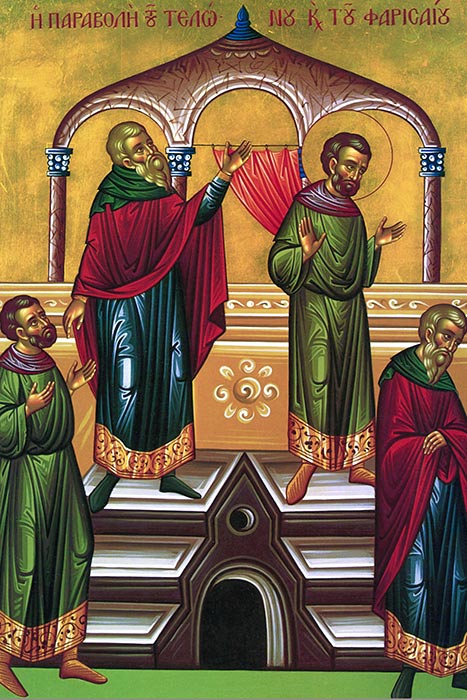 The icon of the Sunday of the Publican and the Pharisee shows both men in the manner in which they enter the temple to pray. The Pharisee goes to a very prominent place where others will see him. The positions of his hands indicate that he is addressing God by speaking of his stature and accomplishments. In contrast, the Publican enters and remains in a low place, far from the holiest parts of the temple. His posture shows his openness to God, his humility, and his petition for mercy.